
Cat Furniture
The Best Cat Tree for Every Kind of Room (2026)
Contents17 sections
- How Tall a Cat Tree Actually Needs to Be
- Platform Width Is the Spec Nobody Checks
- Sisal Outlasts Carpet, and It Also Looks Better Doing It
- Floor-to-Ceiling and Wall-Mounted Beat Freestanding in Tight Rooms
- Wobble Comes From the Base, Not the Weight
- Cat Trees Compared
- Feandrea 67-Inch Multi-Level Cat Tree — Best Overall
- FUKUMARU Floor to Ceiling Cat Tree — Best for Climbers
- Yaheetech 54-Inch Cat Tree Tower — Best Budget Pick
- FUKUMARU Wall-Mounted Cat Tree — Best for Zero Floor Space
- How to Choose a Cat Tree
- FAQ
- How tall should a cat tree be?
- Do cats actually use all the levels on a cat tree?
- Is sisal or carpet better on a cat tree?
- Are wall-mounted cat trees sturdy enough?
- Our Final Verdict
Cats pick one spot on a tower and use it for years. The best cat tree is the one whose top perch is wide enough for a sprawled adult cat, because that single platform does roughly all the work while the middle levels collect dust.
That reframes the whole purchase. Height sells towers and platform width keeps them in use, which is why a 67-inch tree with a generous top beats a 75-inch one with a narrow crow’s nest every time.
After comparing published heights, platform dimensions, post materials and the complaints owners repeat across hundreds of listings, four towers cover the four situations people actually buy for: a normal room, a serious climber, a tight budget, and a floor that has no square inch to spare.
How Tall a Cat Tree Actually Needs to Be
Past about 60 inches, extra height stops changing how a cat uses the tower.
A cat climbs to the highest comfortable surface and stays there. Once the top perch clears the back of the sofa and the windowsill — roughly 50 to 60 inches in most rooms — the cat has what it wanted, and every level above that becomes a step rather than a destination.
The towers that keep selling on height are solving a problem most rooms don’t have. If your ceiling is 8 feet and your cat already naps on top of a 55-inch bookshelf, a 75-inch tower buys you four extra inches of nap altitude and a much harder assembly.
Where height genuinely pays is in a multi-cat home, because two cats will not share a single top perch and a taller tower can offer two separated high spots. Our guide to cat trees for small apartments covers how that changes in a studio.
Platform Width Is the Spec Nobody Checks
A 12-inch round perch is too small for most adult cats, and almost no listing mentions it.
Cats sleep stretched out or curled depending on temperature. A curled cat fits a 12-inch disc; a stretched one hangs off it, and the tower then gets used as a lookout instead of a bed. Perches around 15 to 16 inches across change that behavior completely.
Measure your cat asleep rather than standing. If a sprawling 12-pound shorthair covers 18 inches nose to tail-tip on the sofa, no 12-inch platform will hold that pose, and the hammock or the cave ends up being the only usable surface on the whole tower.
Count the platforms that are actually big enough, not the platforms on the box. A tower advertising six levels where only one takes a full-grown cat is a one-level tower with decoration.
Sisal Outlasts Carpet, and It Also Looks Better Doing It
The carpeted post fails before anything else on a cat tree.
Carpet loops pull out in threads, and once a post starts unravelling it looks shabby from across the room while still being perfectly functional. Sisal rope frays evenly, keeps its color, and on better towers can be rewrapped rather than replaced.
Cats also tend to prefer the coarser surface for scratching, which concentrates wear where you want it. If your cat currently works the corner of a woven rug rather than the sofa arm, a sisal post is the closer match and the more likely substitute.
At around $100, a tower wrapped in beige carpet that will look frayed within a year is a worse deal than a plainer one with sisal posts. We’d pick sisal on every post we could and accept plush only on the perches, where the cat lies still and nothing gets shredded.
Floor-to-Ceiling and Wall-Mounted Beat Freestanding in Tight Rooms
A tension-pole tower claims about one square foot of floor and still gives a cat 9 feet of climbing.
Freestanding towers need a wide base to stay upright, so a 67-inch tree typically occupies a footprint close to 20 by 20 inches. A floor-to-ceiling pole braces against the ceiling instead, which removes the need for that base entirely. A wall-mounted set removes the floor contact altogether.
Consider a 450-square-foot studio where the only free wall is behind a door that opens inward. A freestanding tower blocks the swing; wall shelves mounted at 40 and 60 inches do not. That constraint, not aesthetics, is usually what pushes people to wall mounts.
The cost is permanence and landlord politics. Wall mounts need anchors into studs, and a tension pole presses against a ceiling that has to be solid rather than suspended tile. For a design-led alternative that still stands on the floor, see our picks for a modern cat tree that looks like furniture.
Wobble Comes From the Base, Not the Weight
A heavy tower with a narrow base still rocks, and a light one with a wide base does not.
Stability is geometry. The question is how far the base extends relative to the height, because a cat landing on the top perch from a shelf applies a sideways force that a tall narrow tower converts into a lean. Adding mass to the top makes that worse, not better.
If your cat jumps onto the tower rather than climbing it, prioritize base width and anti-tip hardware over anything else on the spec sheet. A tower that shifts an inch on landing teaches a cat to stop using the top perch within a week.
Most towers over 60 inches ship with a wall strap. Use it. Skipping the strap is the single most common reason a well-reviewed tower gets returned as unstable.
Cat Trees Compared
| Product | Price | Best For | Rating |
|---|---|---|---|
| Feandrea 67-Inch Multi-Level Cat Tree | ~$110 | Most rooms | 4.6 |
| FUKUMARU Floor to Ceiling Cat Tree | ~$180 | Determined climbers | 4.4 |
| Yaheetech 54-Inch Cat Tree Tower | ~$65 | Tight budgets | 4.4 |
| FUKUMARU Wall-Mounted Cat Tree | ~$120 | Zero floor space | 4.3 |
Feandrea 67-Inch Multi-Level Cat Tree — Best Overall
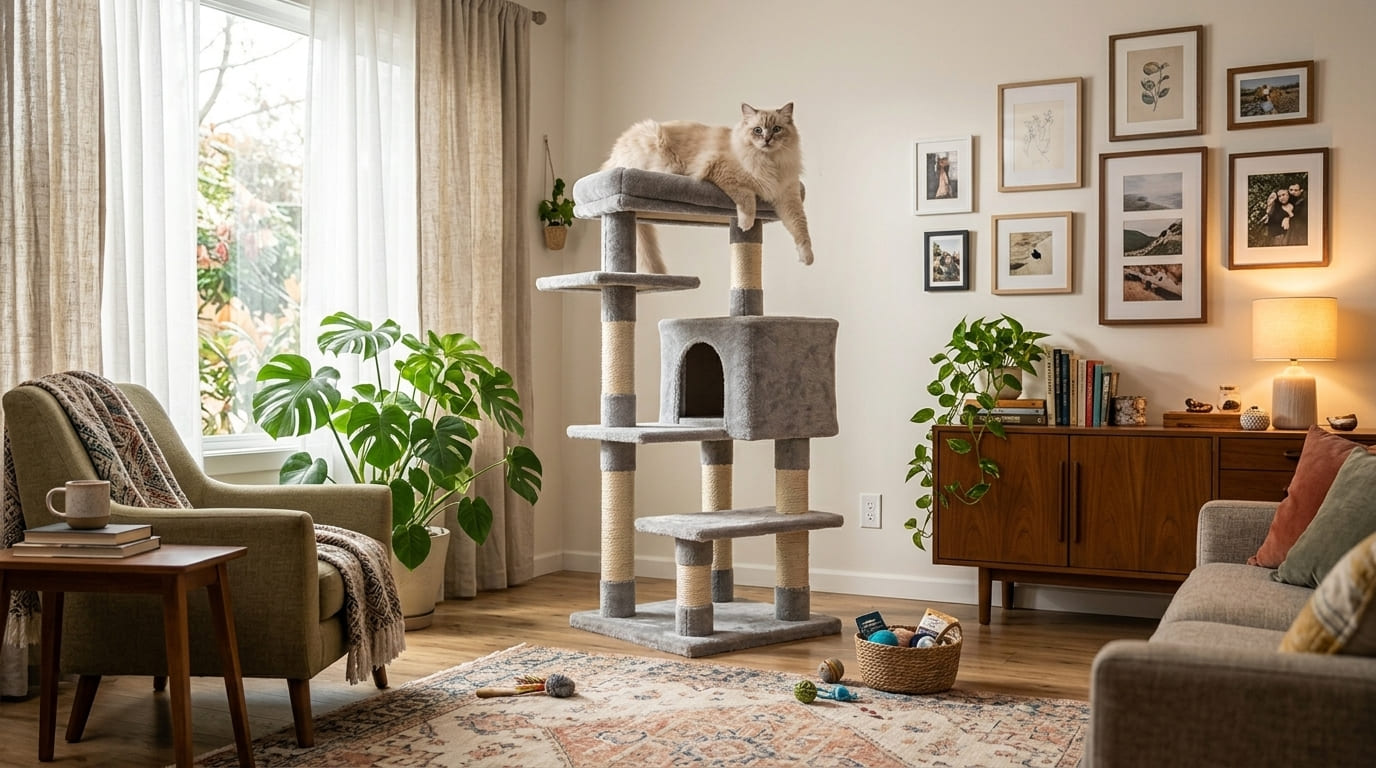
Sixty-seven inches is the height that matters here, because it clears a standard windowsill and the back of most sofas without needing a ceiling brace. The tower carries multiple plush perches, sisal-wrapped posts and a cave at the base, in a light gray that reads as neutral rather than pet-store beige. The perches are sized for a full-grown cat rather than a kitten, which is the spec that separates this from cheaper towers of similar height.
If your living room has a free corner roughly 20 inches square and a window the cat already watches, this is the tower that gets used daily rather than ignored. Position the top perch within jumping distance of the sill and the cat treats the two as one route.
The weakness is assembly and bulk. Multi-level towers of this height arrive as a long list of bolted panels, and the finished object is a substantial piece of furniture that does not move easily once built. Owner reviews also keep circling back to the same point: the plush covering collects fur and needs a vacuum pass more often than a smooth surface would. At around $110 it is still the most sensible buy in the category, because nothing cheaper gives you both the height and the perch width.
Best for: a normal room with a spare corner and a cat that watches the window.
FUKUMARU Floor to Ceiling Cat Tree — Best for Climbers
Six levels on an adjustable pole that extends from 5.7 to 9.8 feet — that range is the entire argument for this design. It braces between floor and ceiling rather than relying on a base, which is why a cat gets nearly three times the vertical travel of a freestanding tower while the tower claims roughly a square foot of floor. Thickened scratching posts, a transparent capsule and a hammock fill out the levels.
Picture a room with 9-foot ceilings and a cat that already climbs the bookcase. A pole tower turns that habit into a sanctioned route, and the top level sits above every surface a human uses, which is where a nervous cat actually wants to be.
What you give up is flexibility. The pole has to meet a solid ceiling, so suspended tiles and sloped ceilings rule it out, and repositioning it means loosening and re-tensioning the whole assembly. At roughly $180 it is also the most expensive option here, and the pole itself does nothing for a cat that never leaves the sofa. We’d only buy it for a cat that demonstrably climbs — for a cat that sleeps at human height, the extra 4 feet is money spent on a view nobody uses, and a 67-inch freestanding tower would get more hours of actual use for sixty dollars less.
Best for: an athletic cat in a room with a solid, flat ceiling.
Yaheetech 54-Inch Cat Tree Tower — Best Budget Pick
Around $65 buys 54 inches, two caves, a kitten-ear perch, a climbing ladder and the usual dangling plush balls, in dark gray. That height is enough to clear a sofa back, and the two enclosed caves matter more than the spec sheet suggests — a cat that dislikes open perches will use a cave on day one.
If this is a first tower for a kitten or a second tower for a room that already has one, the math works: you get most of the usable height for roughly 60% of the price. A kitten growing into it will use the ladder and the lower caves for a year before the top perch becomes the destination.
Where it falls short is longevity and perch size. The covering is carpet rather than sisal on several surfaces, and carpet is what unravels first on a tower that gets daily use. The platforms are also sized closer to a kitten than a 12-pound adult, so a large cat will prefer the caves and leave the upper perch empty. Owner reviews keep returning to the same two points: it arrives looking better than the price suggests, and the carpet shows wear within the first year. It is the right buy at this price and the wrong buy if you only plan to buy one tower ever.
Best for: kittens, second towers, and anyone who will replace it in two years.
FUKUMARU Wall-Mounted Cat Tree — Best for Zero Floor Space
Nothing touches the floor. Five tiers of wall shelves with an integrated scratching post give a small or medium cat a climbing route and a lookout while leaving the entire floor usable, which is a different product category from everything else on this list rather than a variation on it.
Think of the apartment where the only free wall sits behind an inward-opening door, or the room where a robot vacuum has to pass under everything. Mounted at staggered heights, the shelves give the cat a staircase up to a top perch that no freestanding tower could occupy without blocking traffic.
The constraints are real and worth stating plainly. Mounting means drilling into studs, which rules it out for many rentals, and the spacing has to match your cat’s jumping range rather than the diagram — too far apart and a cautious cat refuses the second step. The platforms suit small and medium cats rather than a heavy Maine Coon, and once the anchors are in, moving the arrangement means patching holes. At around $120 it is the most situational pick here, and the only one that works at all in a room with no spare floor. Before drilling, mark the shelf positions in painter’s tape and check the gaps against a jump your cat already makes — a 20-inch rise it clears daily is a safe spacing, and a 30-inch one may not be.
Best for: small apartments where the floor is already fully committed.
How to Choose a Cat Tree
-
Measure the top perch, not the tower. Aim for a platform around 15 to 16 inches across if your cat sleeps stretched out. A tall tower with a 12-inch crown becomes a lookout rather than a bed, and the cat will keep sleeping on the sofa.
-
Match height to the furniture, not the ceiling. The useful target is a top perch that clears the windowsill and the sofa back — roughly 50 to 60 inches in most rooms. Height beyond that only pays in a multi-cat home where two cats need separated high spots.
-
Check the base footprint against the height. A 67-inch tower generally needs a base near 20 by 20 inches to stay steady under a landing cat. If the base looks narrow for the height, the wall strap is not optional.
-
Prefer sisal on posts, plush on perches. Sisal frays evenly and keeps its color; carpet pulls into threads and looks worn within a year. Plush is fine where the cat lies still and bad where it scratches.
-
Decide floor versus wall before you shop. Freestanding, tension pole and wall-mounted are three different answers to the same question, and the one that fits depends on your ceiling, your lease and how much floor you can give up.
FAQ
How tall should a cat tree be?
A cat tree with a top perch between 50 and 60 inches suits most rooms, because that height clears a standard windowsill and the back of a sofa. Taller towers mainly help in multi-cat homes, where two cats need separate high spots rather than one shared perch.
Do cats actually use all the levels on a cat tree?
No. Most cats settle on the highest comfortable platform and use the lower levels as steps rather than destinations. Enclosed caves are the exception — cats that dislike open perches often use a base-level cave as their main spot and ignore the top.
Is sisal or carpet better on a cat tree?
Sisal lasts longer and ages better on scratching posts, because it frays evenly and holds its color while carpet pulls into loose threads. Plush or carpet is fine on perches, where the cat lies still and nothing gets scratched.
Are wall-mounted cat trees sturdy enough?
Wall-mounted cat shelves are sturdy when anchored into wall studs rather than drywall alone, and they suit small to medium cats better than heavy breeds. The common failure is spacing rather than strength — shelves set too far apart get refused by cautious cats.