
Cat Furniture
Feandrea vs Yaheetech Cat Tree: Which Tower Wins (2026)
Contents15 sections
- The 13-Inch Height Gap Matters Less Than It Sounds
- Perch Size Is Where Feandrea Earns the Extra $45
- Yaheetech Wins on Caves, and Caves Beat Perches for Some Cats
- Sisal, Carpet and What Fails First
- Stability: Both Need the Wall Strap
- Feandrea vs Yaheetech at a Glance
- Feandrea 67-Inch Multi-Level Cat Tree — The Better-Built Tower
- Yaheetech 54-Inch Cat Tree Tower — The Smarter Buy for Kittens
- How to Choose Between Feandrea and Yaheetech
- FAQ
- Is Feandrea or Yaheetech better for a large cat?
- Is the extra height on the Feandrea worth it?
- Which cat tree brand lasts longer, Feandrea or Yaheetech?
- Do Feandrea and Yaheetech cat trees need to be anchored to the wall?
- Our Final Verdict
The split between these two brands is height and perch size versus caves and price. Feandrea vs Yaheetech cat tree comes down to one question most buyers never ask: does your cat sleep on top of things, or inside them?
Feandrea builds taller towers with perches sized for a stretched-out adult. Yaheetech builds shorter ones with more enclosed hiding spots, for roughly $45 less. Neither is the better tower in the abstract.
After comparing published heights, platform layouts, post materials and the complaints owners repeat across both brands’ listings, the decision lands on your cat’s age and its habits — not on which tower photographs better.
The 13-Inch Height Gap Matters Less Than It Sounds
Sixty-seven inches versus fifty-four is a real difference, and it changes almost nothing for most cats.
Both towers clear the back of a standard sofa and the height of a typical windowsill. Once a cat has a perch above the furniture line, the extra 13 inches on the Feandrea buys altitude the cat didn’t ask for — it stops being a destination and becomes a number on the box.
Where the gap does matter is a multi-cat home. Two cats will not share one top perch, and the Feandrea’s extra levels give a second cat somewhere high to go that isn’t the first cat’s spot. In a single-cat home that reasoning disappears.
If your ceiling is 8 feet and your cat already naps on a 55-inch bookshelf, both towers land in the same functional band. Our cat tree buying guide covers where height genuinely starts paying off.
Perch Size Is Where Feandrea Earns the Extra $45
The Feandrea’s top platform fits a sprawled adult cat. The Yaheetech’s is sized closer to a kitten, and that single fact decides the purchase for a 12-pound shorthair.
Cats sleep curled or stretched depending on temperature. A curled cat fits almost any perch; a stretched one needs roughly 15 to 16 inches across, and below that the tower becomes a lookout rather than a bed. The cat climbs up, sits, and goes back to the sofa to actually sleep.
Picture a Maine Coon mix that measures 20 inches nose to tail-tip when stretched. On the Yaheetech it will use the caves and ignore the upper perch; on the Feandrea it has somewhere to lie down.
The $45 gap between these towers is almost entirely platform size and build mass. That is a reasonable price for the difference if your cat is full-grown, and money wasted if it is a kitten that will use the caves anyway.
Yaheetech Wins on Caves, and Caves Beat Perches for Some Cats
Two enclosed caves is the Yaheetech’s real advantage, and for a nervous or young cat it outranks every spec Feandrea leads on.
Not every cat wants to be visible. Some settle into an enclosed box at floor level and never use a top perch at all, which makes a tall tower an expensive scratching post with a view nobody uses. The Yaheetech’s lower caves and ladder are built for exactly that cat.
Kittens follow the same pattern for different reasons. A four-month-old kitten uses ladders, caves and lower levels for its first year, and only starts claiming the top perch once it is fully grown and confident.
If you’re buying for a kitten, the honest advice is to spend less now. A $65 tower that gets used for two years and then replaced beats a $110 tower whose best feature stays empty until month fourteen.
Sisal, Carpet and What Fails First
Feandrea wraps more of its posts in sisal; Yaheetech uses more carpet, and carpet is what unravels first.
Carpet loops pull out in threads under daily scratching, and once a post starts coming apart it looks shabby from across the room while remaining perfectly functional. Sisal frays evenly, keeps its color, and on both brands can be rewrapped by hand if you care enough to try.
Consider a cat that already works the corner of a woven rug. That cat will prefer the coarser sisal surface, which concentrates wear onto the posts you want scratched instead of the ones you don’t.
Both towers use plush on the perches, and that’s correct — the cat lies still there, so nothing gets shredded. We’d take sisal on every post that will see claws and accept plush only where the cat sleeps. On that criterion Feandrea is the better-built tower, which is part of what you’re paying for.
Stability: Both Need the Wall Strap
Neither tower is stable enough to skip the included anti-tip strap, and the taller one needs it more.
Stability is geometry rather than weight. A cat landing on a top perch from a nearby shelf applies a sideways force, and a tall tower with a modest base converts that into a lean. The Feandrea’s extra 13 inches makes this worse, not better, because the leverage grows with height.
If your cat jumps onto towers rather than climbing them, strap whichever one you buy to the wall on day one. A tower that shifts an inch on landing teaches a cat to stop using the top perch within a week, and no amount of plush fixes that lesson.
Owner reviews on both brands circle back to the same point: the ones who skipped the strap are the ones describing the tower as wobbly. For placement in a tight room, our guide to cat trees for small apartments covers footprint and clearance.
Feandrea vs Yaheetech at a Glance
| Product | Price | Best For | Rating |
|---|---|---|---|
| Feandrea 67-Inch Multi-Level Cat Tree | ~$110 | Full-grown adult cats | 4.6 |
| Yaheetech 54-Inch Cat Tree Tower | ~$65 | Kittens and cave sleepers | 4.4 |
Feandrea 67-Inch Multi-Level Cat Tree — The Better-Built Tower
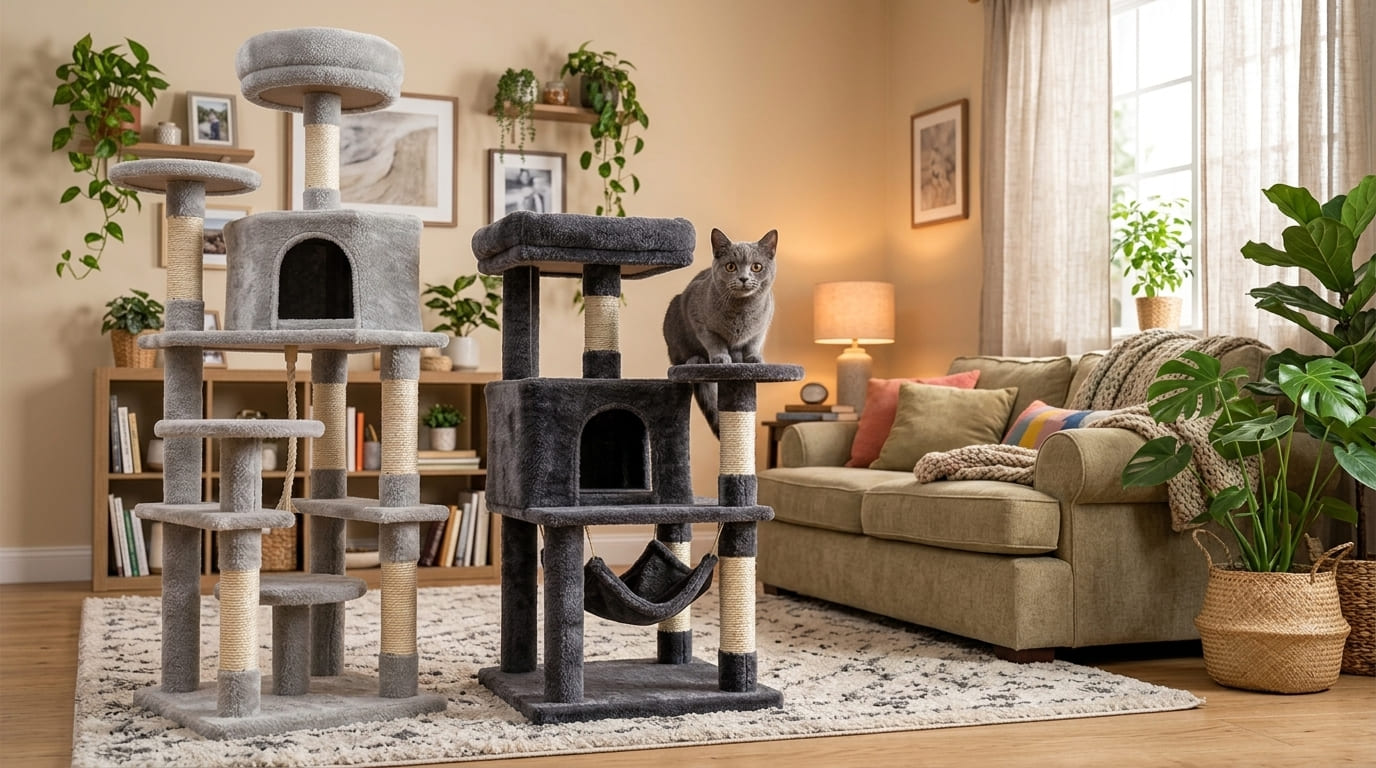
Sixty-seven inches is the headline, but the perch width is the reason to buy it. The light gray tower carries multiple plush platforms sized for a full-grown cat rather than a kitten, sisal-wrapped posts on the surfaces that take claws, and a cave at the base for the days your cat wants to be invisible. The finish reads as neutral furniture rather than pet-store beige, which matters in a living room.
If your corner is roughly 20 inches square and a window sits within jumping distance, position the top perch so the cat treats the sill and the tower as one route. That placement is what turns a tower from decoration into the spot the cat defaults to.
What you give up is bulk and assembly time. A tower this tall arrives as a long list of bolted panels, and once built it is a substantial object that does not move easily. Owner reviews keep returning to the same practical complaint: the plush collects fur and wants a vacuum pass more often than a smooth surface would. At around $110 it is still the better tower of the two in every structural sense, and the right buy if your cat is done growing.
Best for: a full-grown cat that sleeps stretched out, in a home with a corner to spare.
Yaheetech 54-Inch Cat Tree Tower — The Smarter Buy for Kittens
Around $65 buys 54 inches, two enclosed caves, a kitten-ear perch, a climbing ladder and the usual dangling plush balls in dark gray. That height still clears a sofa back, and the two caves do more work than the spec sheet implies — a cat that dislikes open perches will claim a cave on day one and never look up.
Consider a four-month-old kitten in a one-bedroom apartment. It will spend its first year on the ladder and the lower levels, growing into the upper perch slowly, which makes paying for a taller tower now a bet on a cat that doesn’t exist yet.
The weaknesses are longevity and platform size. Carpet covers more surfaces here than sisal, and carpet is what frays first under daily claws. The platforms are sized closer to a kitten than a 12-pound adult, so a large cat will prefer the caves and leave the top empty. Owner reviews repeat two things: it arrives looking better than the price suggests, and the covering shows wear within the first year. That makes it the right buy at $65 and the wrong buy if you only plan to own one tower ever. Think of it as the tower that gets your cat through its first two years rather than its first ten.
Best for: kittens, nervous cave-sleeping cats, and second towers in another room.
How to Choose Between Feandrea and Yaheetech
-
Start with your cat’s age. A kitten will use ladders and caves for a year before claiming a top perch, which makes the cheaper Yaheetech the sensible first tower. A full-grown cat gets the benefit of the Feandrea’s larger platforms immediately.
-
Watch where your cat already sleeps. A cat that naps on the back of the sofa or a bookshelf wants a perch; a cat that disappears into boxes and under beds wants caves. Buy for the habit your cat already has, not the one you hope it develops.
-
Measure your cat asleep, not standing. If a stretched-out cat covers more than about 16 inches, the Yaheetech’s upper perch will not hold that pose and the Feandrea becomes the only real option.
-
Count how many cats need a high spot. Two cats will not share one top perch. The Feandrea’s extra levels create a second separated high spot; in a single-cat home that advantage disappears entirely.
-
Strap whichever one you buy. Both towers ship with anti-tip hardware and both need it, the taller one more than the shorter. Treat the strap as part of assembly rather than an option.
FAQ
Is Feandrea or Yaheetech better for a large cat?
Feandrea is the better choice for a large cat, because its platforms are sized for a full-grown adult to lie stretched out while Yaheetech’s upper perches are closer to kitten-sized. A large cat on a Yaheetech tower will typically use the enclosed caves instead of the top perch.
Is the extra height on the Feandrea worth it?
Not for most single-cat homes. Both towers clear a sofa back and a windowsill, which is the height that matters, so the extra 13 inches mainly helps in multi-cat households where two cats need separate high spots.
Which cat tree brand lasts longer, Feandrea or Yaheetech?
Feandrea generally lasts longer, because it wraps more of its posts in sisal while Yaheetech uses more carpet, and carpet pulls into loose threads under daily scratching. Both use plush on the perches, where the cat lies still and nothing gets shredded.
Do Feandrea and Yaheetech cat trees need to be anchored to the wall?
Yes. Both brands include an anti-tip strap and both towers need it, because stability depends on base width relative to height rather than on total weight. A cat landing on a top perch from a nearby shelf is what makes an unstrapped tower lean.