
Litter & Boxes
PETKIT PuraMax 2 vs Neakasa M1: Drum or Open Top? (2026)
Contents15 sections
- Open Top or Enclosed Drum Decides This Before Price Does
- The Capacity Number Says Nothing About Whether Your Cat Fits
- Odor: Containment Between Cycles vs Speed After Them
- Footprint: One Needs Height, the Other Needs Floor
- Litter Depth Is a Running Cost Nobody Prices
- PuraMax 2 vs M1 Plus at a Glance
- PETKIT PuraMax 2 — Best for Odor and Tight Spaces
- Neakasa M1 Plus — Best for Big Cats and Fussy Ones
- How to Choose Between Them
- FAQ
- Is the PETKIT PuraMax 2 or the Neakasa M1 better for large cats?
- Do cats accept enclosed automatic litter boxes?
- Which has better odor control, an enclosed drum or an open-top litter box?
- Is the Neakasa M1 the same as the M1 Plus?
- Our Final Verdict
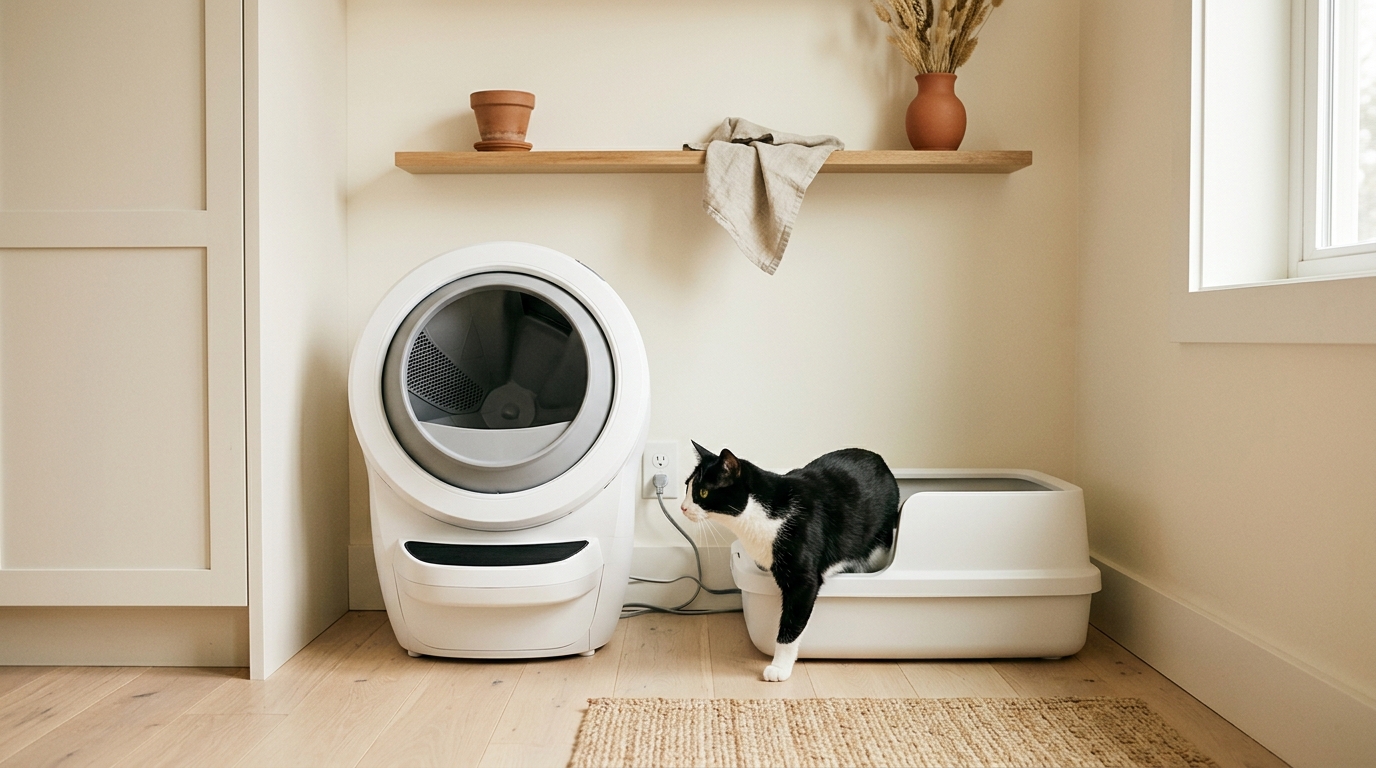
Shape decides this, not features. PETKIT PuraMax 2 vs Neakasa M1 is a choice between an enclosed rotating drum and an open tray with a sifting mechanism underneath, and the cat makes that choice long before the app does.
Both land near $400. Both scoop on their own, connect over WiFi and seal waste in a drawer. Where they separate is the moment your cat approaches: one asks it to step into a tunnel, the other asks nothing at all.
After comparing published designs, entry geometry, odor handling and the complaints owners repeat across both product lines, the decision comes down to two questions — has your cat ever refused a covered box, and how big is it.
A note on naming: searches for the Neakasa M1 land on the M1 Plus in the US, which is the version actually stocked new. That is the model covered here.
Open Top or Enclosed Drum Decides This Before Price Does
A cat that has refused a covered litter box will refuse a rotating drum, and no feature on the spec sheet changes that.
Enclosed automatic boxes ask a cat to walk into a dark cylinder that moves. Most cats accept it within a week. The ones that don’t, don’t — and a $400 machine your cat walks past is worth less than a $25 open tray it uses.
The Neakasa M1 Plus exists for exactly that cat. Nothing covers the tray, so from the cat’s point of view it is an ordinary open box that happens to tidy itself afterward.
Think about the household that already owns a hooded box sitting unused in the hallway while the cat uses the uncovered one in the bathroom. That household should not be reading spec comparisons; it should be buying the open-top machine. Our PuraMax 2 review goes deeper on how the drum behaves day to day.
The Capacity Number Says Nothing About Whether Your Cat Fits
Litter capacity in liters and the space a large cat needs to turn around are different measurements, and only one of them gets advertised.
A drum has a fixed internal diameter. A 20-pound Maine Coon can physically enter one and still not have room to turn comfortably, which shows up as a cat that uses the box but hovers near the entrance. Capacity figures describe how much litter fits, not how much cat fits.
Open-top designs have no ceiling, so headroom stops being a constraint. The tray’s floor area is the only limit, and the cat can position itself however it likes.
If your cat is over roughly 18 pounds or is a long-bodied breed, the open-top design is the lower-risk purchase regardless of which machine has better software. We’d take the M1 Plus for a big cat without weighing the other specs at all.
Odor: Containment Between Cycles vs Speed After Them
The enclosed drum holds odor better between cycles and releases more of it at once when the drawer opens.
That is the honest shape of the trade. A sealed cylinder plus a sealed waste drawer keeps a bathroom neutral for days, and PETKIT ships an odor eliminator module that runs inside the enclosure. Open the drawer to change the bag and the accumulated smell arrives in one go.
The M1 Plus works the other way. Waste drops into the drawer quickly after each use and nothing sits exposed in the tray, so the room stays reasonable — but there is no enclosure holding anything in, which means the drawer seal is doing all the work.
Picture a litter box in a studio apartment’s only bathroom with no window. The enclosed drum is the better bet there, provided you change the bag outside rather than standing over it. In a ventilated utility room the difference narrows to almost nothing.
Footprint: One Needs Height, the Other Needs Floor
The drum is tall and roughly circular; the open-top tray is wide, low and rectangular.
That changes where each one can live. A PuraMax 2 fits a narrow gap between a washing machine and a wall but needs vertical clearance above for the hood and behind for the drawer. An M1 Plus slides under a low shelf or a vanity where the drum will not go, but claims more floor.
Measure the gap you actually have before comparing anything else. A 22-inch alcove with a shelf at 26 inches takes one of these and refuses the other, and no amount of app control compensates.
Both also need clearance at the front for the waste drawer to pull out, so add four inches to whatever number you write down. Our Litter-Robot 4 vs PuraMax 2 comparison covers the clearance trap in more detail.
Litter Depth Is a Running Cost Nobody Prices
A drum needs a minimum standing depth of litter to tumble and separate properly, and that standing volume is money sitting in the machine.
Rotating designs rely on litter weight and depth to carry clumps to the separator. Underfill one and it stops separating cleanly; fill it correctly and several kilograms of litter live permanently inside the drum, topped up rather than replaced.
Sifting trays work at shallower depths because the mechanism rakes rather than tumbles. The practical result is a smaller standing volume and slightly less litter tied up at any moment.
Across a year the difference is modest — one or two extra bags — but it is real, and it points the same direction as the purchase price. Neither machine is cheap to run, and anyone choosing between them on litter cost alone is optimizing the wrong variable.
PuraMax 2 vs M1 Plus at a Glance
| Product | Price | Best For | Rating |
|---|---|---|---|
| PETKIT PuraMax 2 | ~$400 | Odor control, tight gaps | 4.3 |
| Neakasa M1 Plus | ~$400 | Large cats, covered-box refusers | 4.2 |
PETKIT PuraMax 2 — Best for Odor and Tight Spaces
An enclosed rotating drum with a low entrance, app control over 2.4GHz WiFi and safety sensors on the opening — that combination is what you are buying at around $400. The low entry height is the detail that separates it from earlier enclosed designs, because it removes the step-up that makes some cats hesitate at the threshold.
If the box has to live in a bathroom with no window, the sealed cylinder and sealed drawer keep the room neutral for days at a stretch, which an open design cannot match no matter how fast it cycles.
Where it falls short is cat acceptance and interior room. A cat that has already rejected a hooded box is unlikely to change its mind for a motorised one, and the drum’s fixed diameter leaves a very large cat short of turning space. Owner feedback across PETKIT’s enclosed line keeps returning to the same two themes: when it works, it works for years, and when a sensor misreads, the app is where you find out. Anti-leakage and the waste-bag system are solid, and the app is genuinely useful for spotting a stalled cycle while you are out. The decision is not whether the machine works. It is whether your cat will use it at all, and that is answered in the first week or not at all.
Best for: average-sized cats already comfortable with covered boxes, in rooms with poor ventilation.
Neakasa M1 Plus — Best for Big Cats and Fussy Ones
No lid, no tunnel, no ceiling. The M1 Plus sits at roughly the same $400 as its enclosed rival and spends that money on a completely different idea: keep the box looking like a normal open tray to the cat, and hide the mechanism underneath. App control and a sealed waste drawer handle the rest.
Consider a household with a long-bodied cat that currently uses an uncovered tray and has ignored every hooded box it was offered. This is the machine that gets adopted on day one instead of after a two-week negotiation, and that alone is worth the price parity.
The trade is odor and footprint. Without an enclosure, the drawer seal carries the entire burden, so a windowless room will smell more than it would with a drum. It also claims more floor area while needing less height, which suits a vanity or a low shelf and not a narrow alcove. The step accessory helps older or shorter cats reach the tray lip. For a cat that refuses covers, none of the downsides matter more than the one problem it solves. We’d buy it on that basis alone and treat the odor difference as the price of a box that actually gets used.
Best for: cats over about 18 pounds, and any cat that has refused a covered box before.
How to Choose Between Them
-
Start with your cat’s history, not the specs. If it has ever refused a hooded or covered box, buy the open-top design and stop comparing. A rejected machine has no features.
-
Weigh and measure the cat. Over roughly 18 pounds, or long-bodied breeds, want the open tray because a drum’s internal diameter is fixed and headroom is not negotiable.
-
Judge the room’s ventilation. An enclosed drum is the stronger choice in a windowless bathroom; in a ventilated utility room the odor gap between the two narrows to very little.
-
Measure the gap in three dimensions. The drum needs height and a narrow footprint; the open tray needs floor and fits under low shelves. Add four inches at the front on either one for the drawer.
-
Ignore litter cost as a tiebreaker. The standing volume differs by a bag or two a year, which is noise next to a $400 purchase. Decide on shape and size instead.
FAQ
Is the PETKIT PuraMax 2 or the Neakasa M1 better for large cats?
The Neakasa M1 Plus is better for large cats, because its open-top design places no ceiling above the tray and lets a long-bodied cat position itself freely. An enclosed drum has a fixed internal diameter, so a very large cat can enter it and still lack room to turn comfortably.
Do cats accept enclosed automatic litter boxes?
Most cats accept an enclosed automatic litter box within about a week, but cats that have already refused a hooded or covered box usually continue to refuse a motorised one. An open-top automatic box removes that risk because it looks like an ordinary tray to the cat.
Which has better odor control, an enclosed drum or an open-top litter box?
An enclosed drum contains odor better between cycles, because the cylinder and the waste drawer are both sealed. The trade is that opening the drawer releases the accumulated smell at once, while an open-top design spreads a smaller amount continuously.
Is the Neakasa M1 the same as the M1 Plus?
The Neakasa M1 Plus is the version currently stocked new on Amazon in the US, while listings for the plain M1 are typically renewed units or accessory bundles. Searches for the M1 generally lead to the Plus, which shares the same open-top design.