
Litter & Boxes
PetSafe ScoopFree vs Litter-Robot: $470 Apart, Same Floor Space (2026)
Contents13 sections
- Which Costs More Over Two Years?
- Height, Not Floor Space, Is What Separates Them
- Crystals or Clumping Litter: Which One Locks You In?
- Odor and the Chore You Actually Do
- Will Your Cat Actually Use It?
- PetSafe ScoopFree vs Litter-Robot 4 at a Glance
- PetSafe ScoopFree Crystal Pro — Best for One Cat and a Low Shelf
- Whisker Litter-Robot 4 — Best for Multi-Cat Homes
- FAQ
- Is the PetSafe ScoopFree cheaper than the Litter-Robot in the long run?
- Can you use clumping litter in a PetSafe ScoopFree?
- Which is smaller, the ScoopFree or the Litter-Robot 4?
- Our Final Verdict
These two machines solve the same chore in opposite ways. In PetSafe ScoopFree vs Litter-Robot, one is a low open tray with a rake that sweeps waste into a covered trough, and the other is a tall rotating globe that sifts clumping litter into a sealed drawer below.
Most owners assume the $699 machine is simply the better version of the $230 one. It isn’t. They make different demands: one asks you to buy its own disposable trays every month, the other asks for 29.5 inches of vertical space and a cat willing to step inside a globe.
After comparing manufacturer dimensions, litter requirements, tray and refill pricing, and the complaints owners repeat about both, the choice comes down to how many cats share the box and where in the room it has to live.
Which Costs More Over Two Years?
The cheaper machine is only cheaper if you have one cat.
The ScoopFree Crystal Pro sold for $229.99 at the time of writing, and it runs on PetSafe’s disposable crystal trays. Each tray holds about 4.5 pounds of crystals, PetSafe rates it for up to 30 days with one cat, and a 3-pack lists at $73.49 at Chewy, or about $24.50 a tray. That works out to roughly $294 a year for a single cat.
The Litter-Robot 4 costs about $699 and takes any clumping litter, so its running cost is whatever you already pay for litter, plus liners for the drawer.
Now add a second cat. Owner reviews of the ScoopFree trays report two cats getting through a tray in about a week, not a month. At that rate the tray bill passes $1,000 a year, and the Litter-Robot’s higher price is paid back well inside the first year.
If you live with one cat, the ScoopFree wins on cost for years. If you live with two or more, it loses within months.
This round goes to the ScoopFree for one cat, and to the Litter-Robot for two or more.
Height, Not Floor Space, Is What Separates Them
These two take up almost the same floor; one is nearly twice as tall as the other.
The ScoopFree Crystal Pro measures about 29 x 20 x 16 inches. The Litter-Robot 4 measures 22 x 27 x 29.5 inches. Multiply them out and the footprints are within a few square inches of each other: roughly 580 against 594. Buyers expect the compact-looking box to free up floor, and it barely does.
What the ScoopFree saves is height: 13.5 inches of it. That is the difference between fitting under a bathroom vanity, a console table or a low cabinet and not fitting at all. The Litter-Robot needs an open spot with headroom, plus clearance behind it for the drawer.
Consider a one-bedroom flat where the only realistic place for the box is beneath a 24-inch-high floating shelf in the hallway. The ScoopFree slides in with room to spare. The Litter-Robot would have to stand in the open, where it reads as an appliance from every angle.
Our guide to the best automatic litter boxes covers the clearance trap for taller machines in more detail.
This round goes to the ScoopFree.
Crystals or Clumping Litter: Which One Locks You In?
The ScoopFree only works with its own crystal trays; the Litter-Robot works with almost any clumping litter.
That sounds like a footnote and turns out to be the biggest long-term difference. The ScoopFree’s rake is designed around a shallow bed of non-clumping crystals that absorb liquid, while solids are swept into the covered trough at the end. Swap in clumping clay and the system stops working as designed.
The Litter-Robot’s globe sifts clumps out of clay, walnut, tofu or paper litter, whichever your cat already accepts. If you have spent months finding a litter your cat will use, you can keep it.
Crystals also change what the box feels like underfoot. Some cats walk on them without noticing; others dislike the texture and go elsewhere. That is a preference you can only discover by trying, and with the ScoopFree there’s no backup option.
Owner reviews of the tray refills keep circling back to the same complaint: trays that hold less crystal than they used to, and occasional leaks near the end of a tray’s life.
This round goes to the Litter-Robot. We’d pay its premium for the freedom to choose the litter alone.
Odor and the Chore You Actually Do
The ScoopFree asks for one task a month; the Litter-Robot asks for one a week.
With one cat, the ScoopFree’s routine is a tray swap every few weeks: close the lid on the used tray, lift it out, drop in a new one. Nothing gets scooped or bagged, and the box tells you when, with an indicator light and a built-in usage counter.
The Litter-Robot’s waste drawer holds about eight days for a single cat. Pulling it, tying off the liner and fitting a new one takes about 30 seconds, but it comes round every week.
Odor runs the other way. The Litter-Robot seals waste in an enclosed drawer under the globe, so the room stays neutral until you open it. The ScoopFree’s trough is covered, but the tray itself is open and holds a month of absorbed liquid in the crystals by the end of its cycle. In a small, unventilated bathroom, owners notice that difference in the last week of a tray.
If the box sits in a laundry room with a window, the monthly routine is the easier life. If it shares a studio with your sofa, the sealed drawer is worth the weekly pull.
Chores go to the ScoopFree; odor goes to the Litter-Robot.
Will Your Cat Actually Use It?
An open tray is easier for a cat to accept than a rotating globe, whatever the price.
The ScoopFree Crystal Pro, as linked here, is uncovered: from the cat’s side it looks like an ordinary low litter box, with the rake parked at one end. The rake waits until the cat has left before it moves, so there is no moving part while the box is in use.
The Litter-Robot asks the cat to step through an opening into a globe that rotates after it leaves. Many cats accept that within days. Cats that have already refused a hooded box often refuse this too, and a $699 machine your cat walks past is worth less than a $30 tray it uses. We covered the same split between open and enclosed designs in the PuraMax 2 vs Neakasa M1 comparison.
There is a size limit on the other side. Reviewers describe the ScoopFree’s optional hood as a tight fit for an 11-pound cat, so for a large breed, leave it uncovered.
This round goes to the ScoopFree.
PetSafe ScoopFree vs Litter-Robot 4 at a Glance
| Criterion | PetSafe ScoopFree Crystal Pro | Whisker Litter-Robot 4 |
|---|---|---|
| Price | $229.99 at the time of writing | about $699 |
| Dimensions | about 29 x 20 x 16 in | 22 x 27 x 29.5 in |
| Litter | PetSafe crystal trays only | any clumping litter |
| Routine, one cat | tray swap up to every 30 days | drawer about every 8 days |
| Refill cost | about $24.50 per tray | your usual litter plus liners |
| Design | open tray with rake | enclosed rotating globe |
PetSafe ScoopFree Crystal Pro — Best for One Cat and a Low Shelf
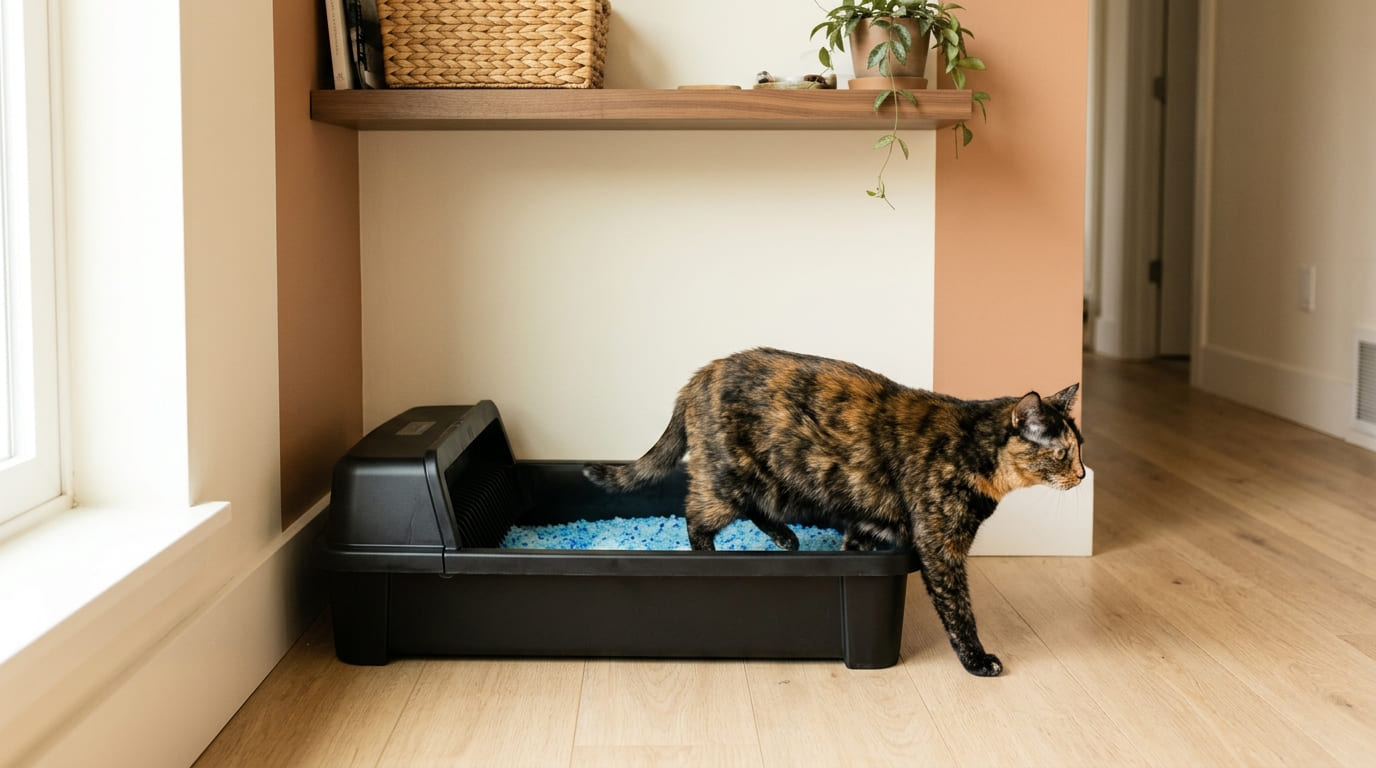
The ScoopFree Crystal Pro is the low-profile option: about 29 x 20 x 16 inches, 18 pounds assembled, built from plastic, and sold for $229.99 at the time of writing against a $299.99 list price. A rake sweeps solids into a covered trough after the cat leaves, crystals absorb the rest, and a light and usage counter tell you when the tray is due. PetSafe rates each tray for up to 30 days with one cat.
If your box has to disappear under a vanity or a low console in a single-cat flat, nothing else at this price is as easy to hide, and the monthly tray swap is the lightest routine of any self-cleaning box we’ve covered.
The price of that simplicity is the tray. You are tied to PetSafe’s refills at about $24.50 each for as long as you own the machine, and owner reviews report that two cats get through one in about a week. Recent reviews of the refills also mention less crystal per tray than before and occasional leaks late in a tray’s life. Each spent tray is also a cardboard tray in the bin, every month, for years. With one cat, it adds up to roughly the same yearly cost as a decent clumping litter. With more, the economics fall apart quickly.
Sits well in a hallway or bathroom where the only space is under something. Black plastic, 16 inches tall, and tucked beneath a 24-inch shelf it reads as a low storage tray rather than a machine.
Whisker Litter-Robot 4 — Best for Multi-Cat Homes
Whisker’s fourth-generation globe is the machine to buy once a second cat moves in. It measures 22 x 27 x 29.5 inches, costs about $699, and takes any clumping litter, so the litter bill stays whatever it is today. The sealed waste drawer holds about eight days for one cat, and Whisker sells individual replacement parts for a machine it has been refining since 2000.
If two cats share one box in a small apartment, the drawer and the open litter choice make the running cost predictable, and the enclosed drawer keeps the room neutral between weekly emptyings in a way an open crystal tray can’t.
Where it falls short is size, noise and acceptance. At 29.5 inches tall it can’t hide under anything, and it needs clearance behind for the drawer. Whisker publishes no decibel figure, and owner reviews keep returning to the sound of the rotation through a thin wall. A cat that has refused a hooded box may refuse the globe too, and the $699 is spent before you find out. We’d still buy it over the ScoopFree the moment there are two cats, because the refill math stops being close.
Belongs in a utility room or a bathroom corner with headroom. A molded plastic globe, 22 inches wide and 29.5 inches tall, and from the doorway it reads as an appliance, so give it a corner rather than a sightline.
FAQ
Is the PetSafe ScoopFree cheaper than the Litter-Robot in the long run?
The PetSafe ScoopFree is cheaper in the long run for a single cat, because one tray at about $24.50 lasts up to 30 days. With two or more cats, owners report trays lasting about a week, which pushes yearly refill costs above $1,000 and makes the Litter-Robot 4 the cheaper machine within the first year.
Can you use clumping litter in a PetSafe ScoopFree?
No, the ScoopFree Crystal Pro is designed around PetSafe’s non-clumping crystal trays. PetSafe makes a separate ScoopFree Clumping model for clumping litter, but the Crystal Pro’s rake and tray system only works as intended with crystals.
Which is smaller, the ScoopFree or the Litter-Robot 4?
The ScoopFree Crystal Pro is much shorter at about 16 inches tall against the Litter-Robot 4’s 29.5 inches, but their floor footprints are almost identical. The ScoopFree measures about 29 x 20 inches and the Litter-Robot 22 x 27 inches.