
Beds & Scratchers
Modern Cat Scratching Post for Furniture Protection That Works (2026)
Contents17 sections
- Why Do Cats Scratch the Sofa Instead of the Post?
- Where Should a Scratching Post Go to Protect Furniture?
- Does It Matter Whether a Scratcher Is Vertical or Horizontal?
- Do Furniture-Style Scratchers Work as Well as Plain Posts?
- When Should You Replace a Worn Scratching Post?
- Best Scratching Posts for Furniture Protection: Comparison Table
- SmartCat Ultimate Scratching Post — Best Overall
- Sofa-Scratcher — Best Anchored Option
- Cat Corner Side Table Scratcher — Best Looking
- Sisal Couch Arm Protector — Best Budget Cover
- What to Look for in a Scratching Post for Furniture Protection
- FAQ
- How do you stop a cat scratching furniture with a scratching post?
- How tall should a scratching post be?
- Why does my cat ignore its scratching post?
- Do sofa corner scratchers really protect furniture?
- Our Final Verdict
A modern cat scratching post for furniture protection has to beat your sofa at the sofa’s own game: it must be at least as tall, at least as steady, and in the same spot. Most posts lose on all three, which is why cats keep going back to the upholstery.
Looks come second to that contest. A beautiful 24-inch post that rocks when a cat leans into it will be ignored in favor of a sofa arm that never moves, however good the post looks beside it.
After comparing post heights, base dimensions, anchoring methods, replaceable surfaces and owner feedback across dozens of scratchers, four stand out for protecting furniture specifically. One is a 32-inch classic, one anchors under the sofa itself, one doubles as a side table, and one covers the arm directly.
Why Do Cats Scratch the Sofa Instead of the Post?
Cats scratch the sofa because it’s usually taller, heavier and better placed than the post meant to replace it. A sofa arm doesn’t move when a cat pulls on it, and it sits in the middle of the room where the cat spends its day.
Most scratching posts lose to the sofa on stability, not appeal. A post that shifts even slightly under a full stretch feels wrong to a cat, and a sofa weighing 100 pounds never does.
Height is the second test most posts fail. A cat reaching up at full stretch wants to pull downward against something solid, so a 20-inch post forces a crouch the sofa arm doesn’t. The SmartCat Ultimate Scratching Post stands 32 inches tall on a 16 x 16-inch base, which is exactly why it keeps coming up in owner recommendations as a sofa replacement.
If your cat is already working on the side of an armchair, measure how high the claw marks reach before buying anything. The post you choose needs to clear that height with room to spare. The compact towers in our guide to cat trees for small apartments solve the same problem when a single post isn’t tall enough.
Where Should a Scratching Post Go to Protect Furniture?
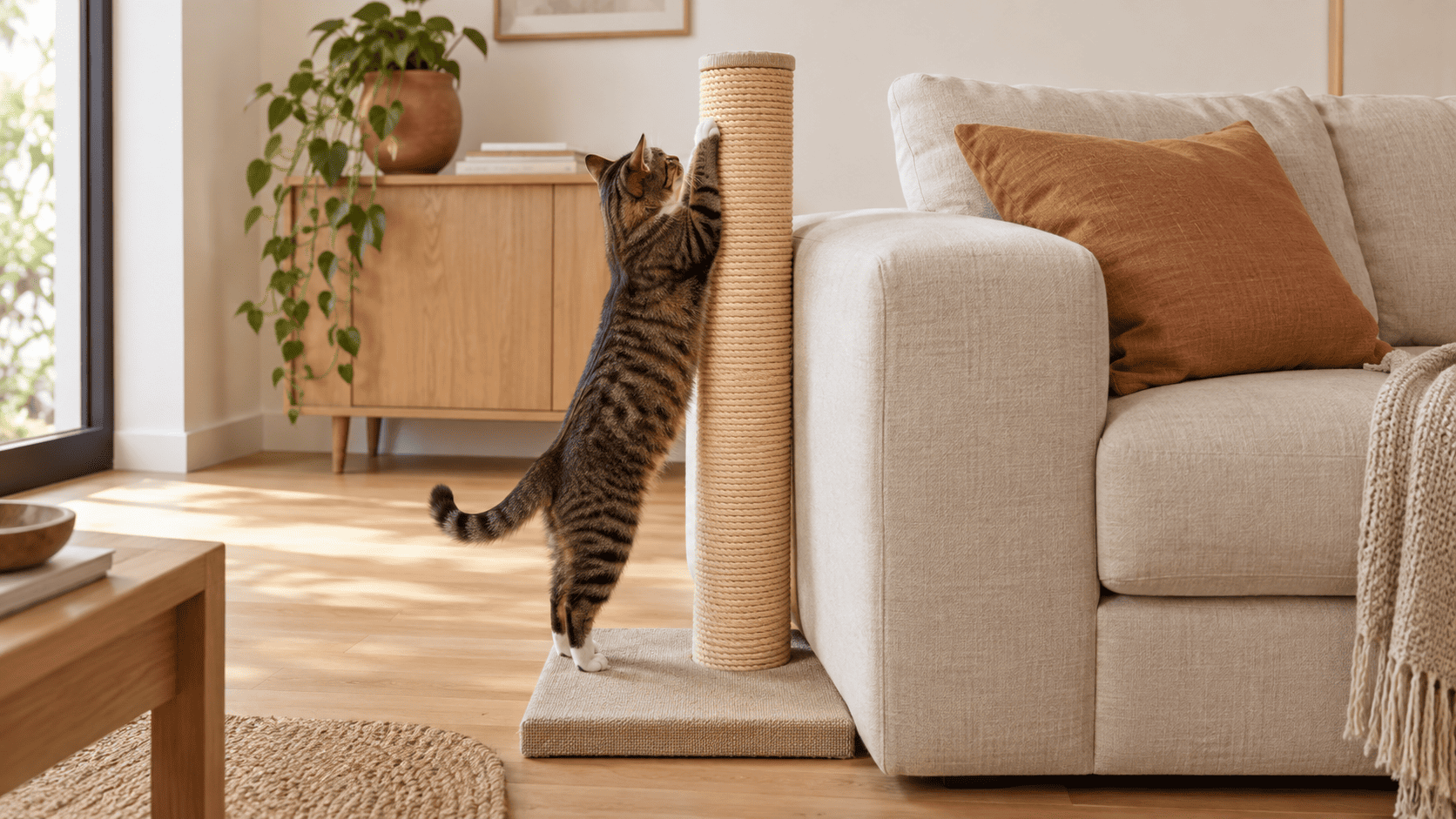
A scratching post protects furniture only when it sits directly in front of the damaged spot, touching it or close enough to block it. A post across the room is competing with the sofa, not replacing it.
The best base for a scratching post can be the sofa itself. The Sofa-Scratcher uses a low-profile base that slides under the sofa’s leg, so the furniture’s weight anchors the post in place and it cannot tip, slide or be nudged away.
That solves the stability problem and the placement problem in a single move. The post sits exactly where the damage happens, and it’s as immovable as the sofa it’s guarding.
If your cat attacks the front corner of the sofa arm, the post belongs on that corner and nowhere else. Once the cat is reliably using it, leave it there rather than moving it somewhere tidier, since a post that’s been relocated two feet from the target turns back into an optional alternative. Owners who move a working post are the most common reason sofa scratching returns.
Does It Matter Whether a Scratcher Is Vertical or Horizontal?
Orientation matters, and the damage on your furniture tells you which one to buy. Vertical claw marks down the side of a sofa arm mean your cat wants to scratch upright; shredded fabric on a seat cushion or a rug means it prefers horizontal.
A flat pad won’t stop a cat that scratches up the side of a sofa. It’s the most common mismatch in this category, because horizontal cardboard pads are cheap and popular, and a vertical scratcher simply ignores them.
Look closely at the damage before buying. Long parallel tears running up and down the side of an arm point to a vertical post like the SmartCat Ultimate Scratching Post; frayed patches across a flat top point to a horizontal surface instead.
Corners need their own answer. If the damage wraps around the front edge of the arm, a flat panel only covers one side of it. That’s where an L-shaped design helps, since the Cat Corner Side Table Scratcher runs its reversible sisal around the angle and fits either the left or right arm of a sofa.
Do Furniture-Style Scratchers Work as Well as Plain Posts?
Furniture-style scratchers often work better than plain posts for protecting a sofa, because they sit exactly at the sofa’s end and owners are far less likely to move them. A side table with sisal panels has a reason to stay beside the sofa permanently.
The prettier option can be the more effective one here. A plain post that looks like pet equipment gets pushed into a corner the day guests arrive; a side table with a lamp on it stays put, and staying put is what keeps the cat scratching there.
The Cat Corner Side Table Scratcher stands 23.5 inches high in an oak finish, with a surface for coffee, remotes and a lamp above its sisal scratching area.
The trade is height. At 23.5 inches, a side-table scratcher is lower than a dedicated 32-inch post, so it suits cats that scratch the lower front of an arm better than cats that stretch to the top of a high-backed chair. If your cat’s claw marks sit near the top of the furniture, a tall freestanding post still does the job better, however good the side table looks.
When Should You Replace a Worn Scratching Post?
Replace a scratching post only when the sisal has worn through to the core or the post has started to wobble. Shredded, frayed sisal is not a failed post; it’s a post your cat has been using.
A tidy, new-looking post can be less attractive to a cat than a shredded one. The frayed texture of a well-used sisal wrap gives claws more to catch on, which is why replacing a post at the first sign of wear sometimes sends a cat back to the sofa.
Some designs extend that life deliberately. SmartCat owners note that the post can be unscrewed from its base and flipped over, putting the unworn end at scratching height and roughly doubling its usable life. The Cat Corner Side Table Scratcher uses a removable hook-and-loop sisal pad that lifts off for replacement without replacing the table.
If you’re about to throw out a scratched-up post, check whether it wobbles first. A steady post with frayed sisal is doing its job, while a wobbly post with fresh sisal isn’t.
Best Scratching Posts for Furniture Protection: Comparison Table
| Product | Price | Best For | Rating |
|---|---|---|---|
| SmartCat Ultimate Scratching Post | ~$45 | Best overall | 4.7/5 |
| Sofa-Scratcher | ~$50 | One sofa corner | 4.3/5 |
| Cat Corner Side Table Scratcher | ~$80 | Living room style | 4.3/5 |
| Sisal Couch Arm Protector | ~$20 | Single armrest | 4.1/5 |
SmartCat Ultimate Scratching Post — Best Overall
Thirty-two inches of height on a 16 x 16-inch base is the combination that lets this post compete with a sofa. SmartCat wraps it in woven sisal fiber and attaches the post to the base with two screws, and the wide square footing is what keeps it from tipping or wobbling under a full-stretch pull. It comes in neutral beige and gray rather than pet-store colors.
If your cat scratches the side of a sofa arm or the back of an armchair, this is the post to put directly in front of the damage. The 32-inch height clears the reach of most adult cats, and owners in Amazon’s Q&A describe cats standing on the base with their back legs while reaching up, which is exactly the stance that makes a post feel as solid as furniture.
It won’t win a design award. This is a plain sisal column on a flat base, closer to functional equipment than decor, and the listing’s own styling can’t change that. Sisal also sheds small fibers as it wears. Its big advantage over prettier posts is durability, since unscrewing and flipping the post gives it a second life once the top wears down. We’d buy it first and add something more decorative later.
Best for: Cats that scratch high on the side of sofas and armchairs.
Sofa-Scratcher — Best Anchored Option
Sliding its base under your sofa’s leg is the idea that makes this one different. The Sofa-Scratcher is a contoured, sisal-covered scratch panel on a low-profile base, and once that base sits beneath the furniture leg, the sofa’s own weight holds the post in place. No freestanding post can match that stability, because nothing on a freestanding base weighs as much as the sofa does.
If your cat has chosen one specific corner of the sofa and ignores posts placed nearby, this puts the scratching surface exactly on that corner. It also can’t be knocked over or pushed away during an enthusiastic session, which matters for cats that lean their full weight into scratching.
Placement options are the limitation. It only works beside furniture with a leg you can slide the base under, so sofas with plinth bases that sit flat on the floor are out. It’s also a single-purpose panel rather than a piece of furniture, so it stays visible as a cat product. The contoured panel is also narrower than a full post, so a large cat gets less surface to work with. For a cat locked onto one sofa corner, though, nothing else here protects that spot as reliably, and it costs less than replacing the upholstery it saves.
Best for: Cats fixated on one sofa corner that ignore nearby posts.
Cat Corner Side Table Scratcher — Best Looking
Doubling as an end table is what earns this scratcher a permanent place beside the sofa. It stands 23.5 inches high in an oak finish, with a wood frame, sisal scratching posts and a removable hook-and-loop sisal pad, topped by a surface for coffee, remotes, a phone or a lamp. The reversible L-shaped profile fits either the left or the right arm.
If your sofa has an empty gap at one end where a side table would go anyway, this fills it with something useful to both of you. Because it sits flush against the arm, it covers the front corner that cats target most, and the L-shape wraps around the angle rather than guarding only one face of it.
At 23.5 inches it’s lower than a dedicated post, so cats that stretch to the top of a high sofa back may still prefer the upholstery. The hook-and-loop pad is a genuine advantage, since it lifts off for cleaning or replacement without buying a new table. The listing is also recent, so long-term durability data is thin. Orientation is flexible because the L-shape reverses, which spares you the left-or-right guessing that catches out buyers of single-sided corner designs. For a living room where looks matter, we’d choose it over any plain post on this list.
Best for: Living rooms where the scratcher has to pass as furniture beside the sofa.
Sisal Couch Arm Protector — Best Budget Cover
Covering the target itself is the simplest furniture protection there is. This protector drapes a natural sisal scratching mat over the sofa arm, with a sisal area of 19.7 x 23.6 inches, so the spot your cat already uses becomes a scratching surface rather than bare upholstery. The whole pad can be hand-washed.
If your cat scratches the arm and nowhere else, this works without adding any new object to the room, since the protection lives on the sofa. That makes it the lowest-commitment option here, and a quick way to find out whether redirecting the cat to sisal works before spending more.
Fit is the dealbreaker to check first: the manufacturer notes it installs easily on armrests under 12 inches wide and may not secure firmly on wider ones. It’s also sided, and the left or right is judged while sitting on the sofa, not facing it, which catches people out at checkout. Draped sisal over upholstery is the least attractive look here too. Hand-washing is the upkeep, and the manufacturer asks for water below 30°C and no wringing, so it’s not a throw-in-the-machine item. As a cheap first step that tells you whether sisal redirects your cat before you spend more, it does the job well.
Best for: Budget-minded owners protecting a single armrest under 12 inches wide.
What to Look for in a Scratching Post for Furniture Protection
-
Match or beat the height of the damage. Measure how high the claw marks reach on your furniture, then choose a post that clears it. Around 32 inches suits most adult cats that scratch upright.
-
Prioritize stability over looks. A wide base, such as a 16 x 16-inch footing, or a base anchored under the sofa leg keeps the post from moving, and a post that moves gets ignored.
-
Read the orientation from the damage. Vertical marks down a sofa side call for an upright post; frayed patches on flat surfaces call for a horizontal scratcher.
-
Check left, right and width. Corner and armrest designs are often sided, and armrest covers may only fit arms under a certain width. Confirm both before ordering.
-
Look for replaceable or reversible surfaces. A flippable post or a removable sisal pad extends the life of the scratcher without replacing the whole unit.
FAQ
How do you stop a cat scratching furniture with a scratching post?
Place a sturdy scratching post directly in front of the exact spot your cat is scratching, and make sure it’s at least as tall and as stable as the furniture. Cats choose the sofa because it doesn’t move and sits in the right place. Once the cat uses the post reliably, leave it there.
How tall should a scratching post be?
A scratching post should be tall enough for an adult cat to reach up at full stretch, which for most cats means around 32 inches. Shorter posts force a crouch and often lose out to a sofa arm or the back of a chair. Measure the height of existing claw marks as a guide.
Why does my cat ignore its scratching post?
Cats usually ignore a scratching post because it wobbles, is too short, or sits away from where they want to scratch. A post that shifts under a full stretch feels unstable compared with a heavy sofa. Moving the post directly beside the furniture your cat targets is the most common fix.
Do sofa corner scratchers really protect furniture?
Sofa corner scratchers protect furniture well when they cover the exact area your cat scratches and stay firmly in place. Designs that anchor under the sofa leg or sit flush against the arm as a side table are the hardest to dislodge. Check whether the design is left- or right-sided before buying.