
Beds & Scratchers
Sisal vs Cardboard Cat Scratcher: Which Lasts? (2026)
Contents17 sections
- Cats Choose an Orientation Before They Choose a Material
- Cardboard Is Cheaper to Buy and More Expensive to Own
- The Mess Is Daily With Cardboard and Occasional With Sisal
- How Each Material Reads in a Living Room
- Height and Wobble Decide Whether a Post Gets Used
- Sisal vs Cardboard Scratchers Compared
- TINYBEAST 35-Inch Sisal Cat Scratching Post — Best Overall
- Conlun Vertical Cardboard Cat Scratcher — Best Cardboard Pick
- Sisal Mat Scratching Post with Wooden Base — Best for Low Scratchers
- MECOOL Cardboard Scratching Pads (3-Pack) — Cheapest Way to Experiment
- How to Choose Between Sisal and Cardboard
- FAQ
- Do cats prefer sisal or cardboard?
- How long does a cardboard cat scratcher last?
- Is sisal rope or sisal fabric better for a scratching post?
- How tall should a cat scratching post be?
- Our Final Verdict
Orientation predicts use better than material does. The sisal vs cardboard cat scratcher question matters far less than whether the thing stands upright or lies flat, because a cat that scratches vertically will ignore a horizontal pad in either material.
Once orientation is settled, the two materials split cleanly on money and mess. Sisal costs more upfront and lasts years; cardboard costs a few dollars and gets replaced every couple of months, leaving shavings on the floor the whole time.
After comparing published dimensions, base construction, replacement intervals and the complaints owners repeat across hundreds of listings, four products cover the four combinations: tall sisal, vertical cardboard, flat sisal and flat cardboard.
Cats Choose an Orientation Before They Choose a Material
Watch where your cat already scratches and the material question mostly answers itself.
A cat that works the vertical face of a sofa arm wants something upright and tall enough to reach into. A cat that shreds the rug wants something flat. Buy the wrong orientation in the better material and it sits unused in a corner, which is how most people conclude their cat “doesn’t like scratchers”.
The sofa arm is the clearest signal there is. If the damage runs up and down the fabric rather than across the seat, a flat cardboard pad will not redirect it no matter how much catnip ships with it.
Some cats do both, and the honest answer there is to buy one of each in the cheap material first. A $12 cardboard pad and a $14 vertical cardboard scratcher cost less than one sisal post and tell you what to spend the real money on. Our guide to scratchers that look good covers the design end once you know the answer.
Cardboard Is Cheaper to Buy and More Expensive to Own
A $10 cardboard pad replaced every two months costs $60 a year. A $45 sisal post lasts several.
That arithmetic flips the usual assumption about which material is the budget option. Corrugated cardboard is consumable by design — the cat shreds the exposed edges, you flip it, the cat shreds the other side, and then it goes in the recycling. Three-packs exist because one pad is not a purchase, it’s a supply.
Sisal rope wears differently. The fibers fray and compress but the post keeps functioning, and a post that cost $45 in year one costs nothing in years two and three.
If your cat is a heavy scratcher and you’re choosing on price alone, sisal wins over any horizon longer than about eight months. We’d buy cardboard deliberately as a cheap experiment or for a cat that genuinely prefers it, not as the economical choice — because across three years it isn’t one.
The Mess Is Daily With Cardboard and Occasional With Sisal
Cardboard sheds confetti every time it is used, and that is the complaint owners repeat most.
Fine paper shavings collect around the pad and travel on paws into the rest of the room. A pad in a living room means sweeping or vacuuming around it several times a week, which is a real chore attached to a product sold as low-maintenance.
Sisal sheds too, but differently: loose fibers appear in handfuls every few weeks rather than crumbs every day, and they don’t scatter the same way.
Consider a cardboard lounge placed next to a sofa on a dark hardwood floor. Pale shavings show against dark wood from across the room, which is exactly where most people put the thing. Moving it onto a washable mat solves the visual problem and adds a mat you now have to clean. A tall sisal post in the same spot creates no equivalent daily task.
How Each Material Reads in a Living Room
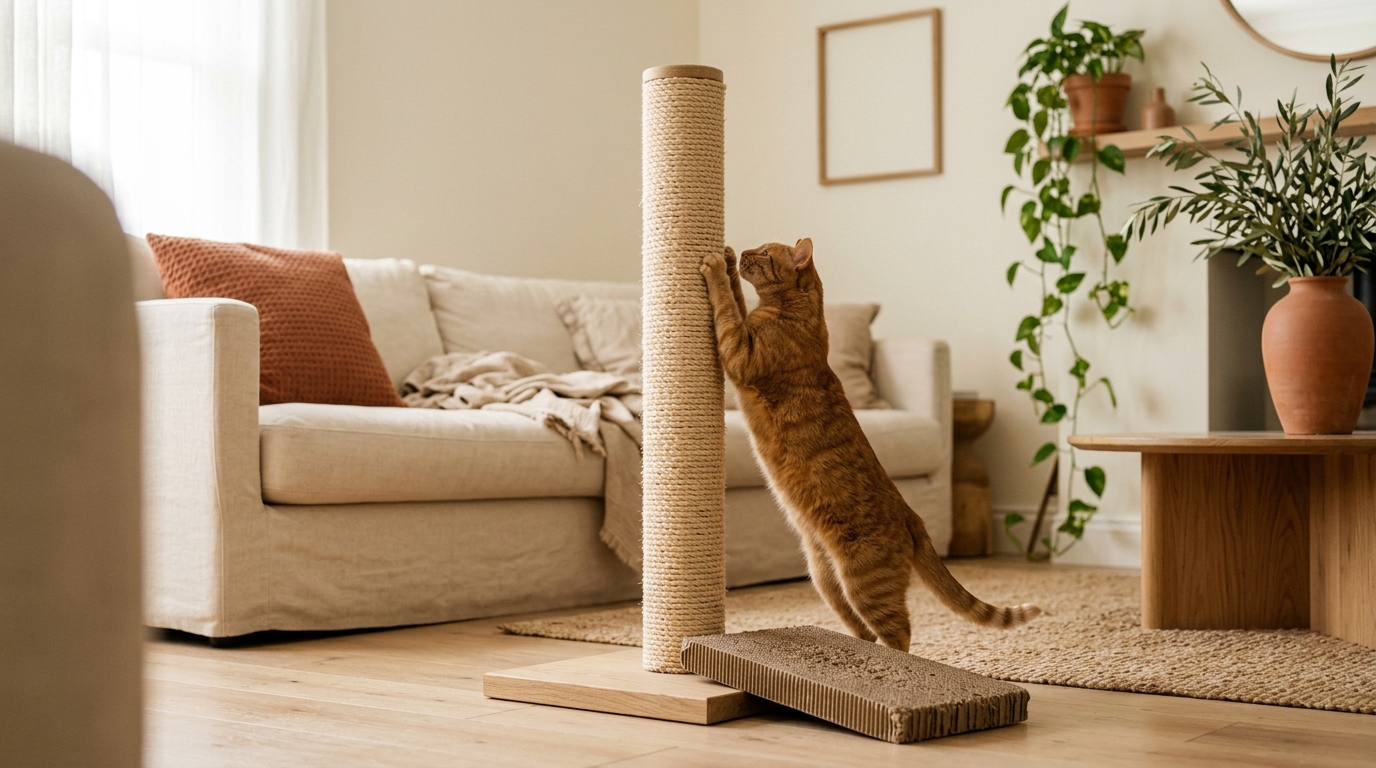
A sisal post on a solid wood base looks like a piece of furniture; a cardboard pad looks like packaging, because that is what it is.
That difference decides the purchase for anyone whose scratcher sits in a visible room rather than a spare bedroom. Natural sisal rope over a pale wooden base sits comfortably in a Scandinavian or mid-century room, and the colors are neutral enough that it disappears into a space rather than announcing itself.
Cardboard has one aesthetic advantage worth naming: the curved lounge shapes read as sculptural in a way a flat brown pad does not. A single curved scratcher in a neutral finish beside a sofa looks intentional.
What ruins both is carpet. A sisal post wrapped in beige carpet over its base, or a cardboard pad printed with paw graphics, is the version that looks like it came from a pet store. We’d pay $10 more for plain sisal over patterned carpet every time — see our picks for a modern scratching post if the room matters as much as the function.
Height and Wobble Decide Whether a Post Gets Used
A sisal post under about 28 inches is too short for a grown cat to reach full extension, and a post that rocks gets abandoned within a week.
Both failures are structural rather than material. Cats reach up as far as they can and pull down, which applies real force at the top of the post — and a narrow or light base converts that force into a lean. The cat notices immediately and goes back to the sofa.
Picture a 12-pound shorthair reaching up a 24-inch post. Its front paws are near the top before it has fully extended, so the post offers nothing the arm of a chair doesn’t. At 35 inches the same cat gets the full motion.
Cardboard scratchers sidestep this entirely by being low or by lying flat, which is part of why they work for some cats and not others. For vertical cardboard, the equivalent failure is a light base sliding across a hard floor instead of tipping.
Sisal vs Cardboard Scratchers Compared
| Product | Price | Best For | Rating |
|---|---|---|---|
| TINYBEAST 35-Inch Sisal Post | ~$45 | Vertical scratchers, long term | 4.5 |
| Conlun Vertical Cardboard Scratcher | ~$25 | Vertical on a budget | 4.3 |
| Sisal Mat Scratching Post | ~$35 | Low and flat scratchers | 4.2 |
| MECOOL Cardboard Pads (3-Pack) | ~$25 | Testing what your cat likes | 4.3 |
TINYBEAST 35-Inch Sisal Cat Scratching Post — Best Overall
Thirty-five inches is the number that matters here, because it clears the threshold where a full-grown cat can reach up and pull down through the whole motion rather than stopping short. Natural sisal rope wraps the pole, and the base is thick solid wood rather than a particleboard disc — which is the part that decides whether the post stays upright under a hard pull.
If your cat currently works the vertical face of a sofa arm, place this within a couple of feet of that spot rather than in a corner across the room. Cats redirect to a nearby alternative far more readily than to a better one further away.
The weakness is footprint and price. A wooden base wide enough to resist tipping takes real floor space, and around $45 is four times what a cardboard three-pack costs on day one. There is also no hiding what it is: this is a scratching post, not a piece of furniture that happens to scratch. Assembly is a single bolt through the base, so there is no building involved. For a cat that scratches vertically and a household that plans to own one scratcher for years, it’s the one we’d buy without hesitating, and the one that stops the sofa-arm problem fastest.
Best for: adult cats that scratch upright, in homes buying once rather than repeatedly.
Conlun Vertical Cardboard Cat Scratcher — Best Cardboard Pick
Reversibility is the design idea: this one stands vertically against a wall or lies flat, so a single purchase covers both orientations while you work out which your cat wants. At roughly $25 it costs about half a comparable sisal post and answers the orientation question without committing you to a material.
Consider a new cat in a rental where drilling anything to the wall is out of the question. A freestanding vertical cardboard scratcher leans where the cat already scratches, and if the cat ignores it upright, you flip it flat and try again.
Where it falls short is the shedding and the lifespan. Corrugated cardboard produces fine shavings every session, so expect a sweep around it two or three times a week, and expect to replace it within a few months of heavy use. Vertical cardboard also needs weight or a wall behind it — on a hard floor without either, it slides rather than taking the force. Buy it as the flexible, low-commitment option it is, not as a long-term fixture. Treated that way it does its job well: it tells you within two weeks whether your cat is a vertical scratcher, and that answer is worth more than the $25 it costs.
Best for: new cats and renters who want to test orientation before spending more.
Sisal Mat Scratching Post with Wooden Base — Best for Low Scratchers
Sisal in a flat or low format is unusual, and that is the entire reason this one exists. It pairs a sisal scratching surface with a wooden base for cats that scratch close to the ground — the rug-shredders — while giving them the durable material instead of a consumable one.
If the damage in your home runs across the carpet rather than up the furniture, this is the product that matches the behavior you actually have. A flat sisal surface placed on the route your cat already walks gets found within a day or two.
The trade is versatility and height. This will not satisfy a cat that wants to reach up, and at around $35 it costs more than a cardboard pad that does the same job in the same orientation for a fraction of the money — you are paying for years of life rather than months. Owner feedback on this format circles back to one point consistently: the sisal surface takes longer for a cat to adopt than cardboard does, because cardboard gives more immediately under claws. Give it two weeks before concluding it failed, and place it where the cat already walks rather than where you would like it to be. A flat scratcher in the wrong room gets ignored regardless of material.
Best for: cats that scratch the carpet, in homes that don’t want a consumable.
MECOOL Cardboard Scratching Pads (3-Pack) — Cheapest Way to Experiment
Three reversible pads for around $25 works out near $8 each, and that price is the argument. Each pad flips over when one side is shredded, which roughly doubles its usable life, and having three means you can place them in three different rooms and watch which one gets used.
Picture a household that has just adopted a cat and has no idea what it prefers. Putting a pad beside the sofa, one by the bedroom door and one near the window costs less than a single sisal post and produces an answer within a week, with no guessing about rooms or orientation.
What you give up is everything sisal offers: these are consumables that will be in the recycling within a few months, they shed shavings onto the floor constantly, and three brown corrugated pads in a living room look like exactly what they are. We’d treat this as research spending rather than a purchase — buy the pack, learn where and how your cat scratches, then spend properly on one good post in the orientation the cat actually chose. Three cheap pads that answer the question beat one expensive post that guesses wrong, and the pack costs less than a single month of replacing one pad at a time.
Best for: new cat owners working out where and how their cat scratches.
How to Choose Between Sisal and Cardboard
-
Identify the orientation first. Look at the existing damage in your home. Vertical marks on sofa arms and door frames mean a tall post; horizontal shredding on rugs and carpet means a flat pad. Material is the second question, not the first.
-
Calculate cost per year, not per unit. A cardboard pad replaced every two months runs about $60 annually; a $45 sisal post lasts several years. Cardboard is the cheaper purchase and the more expensive habit.
-
Decide how much daily mess you’ll accept. Cardboard sheds fine shavings every session and needs sweeping two or three times a week. Sisal sheds loose fibers occasionally. On dark floors the difference is highly visible.
-
Measure for height on any vertical post. Below about 28 inches a grown cat cannot reach full extension, which makes the post no more appealing than a chair arm. Thirty-two to thirty-six inches covers almost every adult cat.
-
Check the base before the surface. A wide, heavy base is what keeps a post from rocking under a hard pull, and a post that rocks gets abandoned within a week. Solid wood beats a thin particleboard disc at any price.
FAQ
Do cats prefer sisal or cardboard?
Cats show no consistent preference between sisal and cardboard, but they do show strong preferences for orientation — vertical or horizontal. A cat that scratches the sofa arm wants an upright surface, and it will ignore a flat pad in either material.
How long does a cardboard cat scratcher last?
A corrugated cardboard scratcher typically lasts around two months with a single regular scratcher, and roughly twice that if it is reversible and you flip it halfway through. Sisal posts measure their life in years rather than months.
Is sisal rope or sisal fabric better for a scratching post?
Sisal rope is the more common and more durable option on posts, because the twisted fibers give under claws while holding their shape. Sisal fabric is flatter and suits horizontal mats, where the surface takes pressure rather than pulling force.
How tall should a cat scratching post be?
A scratching post should be at least 28 inches tall for an adult cat, with 32 to 36 inches covering nearly all of them. Below that height a cat cannot reach full extension, which makes the post no more useful than the arm of a chair.