
Litter & Boxes
Best Hidden Litter Box Furniture That Looks Like Real Furniture (2026)
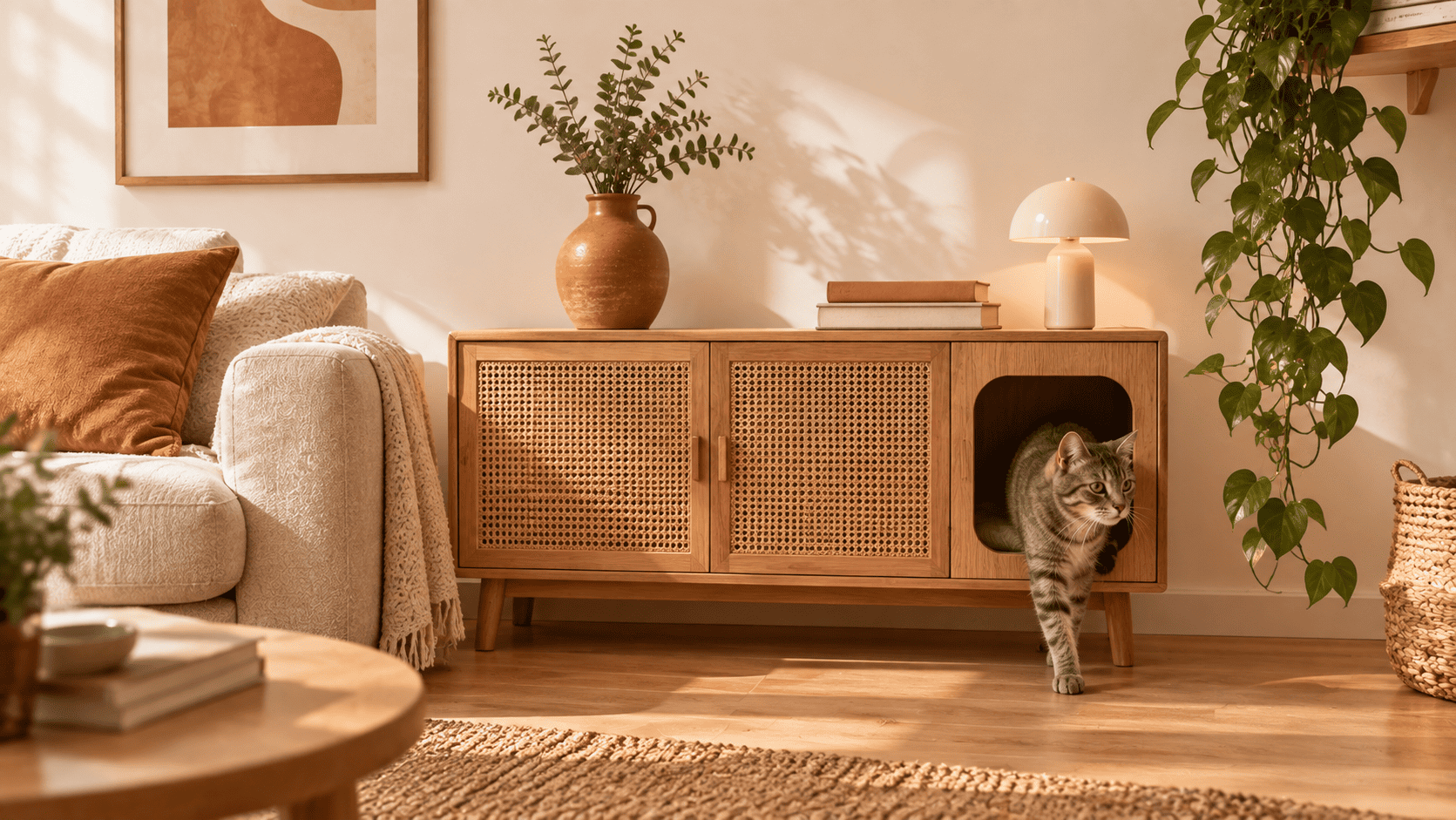
Contents17 sections
- What Makes Hidden Litter Box Furniture Actually Work?
- How Big Should a Litter Box Cabinet Be?
- Will a Cat Use an Enclosed Litter Box?
- Which Materials and Finishes Look Best in a Living Room?
- What Should You Expect on Odor and Litter Tracking?
- Best Hidden Litter Box Furniture: Comparison Table
- HOOBRO Litter Box Enclosure — Best Overall
- HOOBRO Rattan Door Enclosure — Best Looking
- unipaws Top Opening Enclosure — Best for XL and Automatic Boxes
- 2-in-1 Wooden Cat Washroom Cabinet — Best for Narrow Spaces
- What to Look for When Choosing Hidden Litter Box Furniture
- FAQ
- Does hidden litter box furniture help with odor?
- What size cabinet do I need for my litter box?
- Will my cat use a litter box inside furniture?
- Can hidden litter box furniture fit an automatic litter box?
- Our Final Verdict
The best hidden litter box furniture is judged on how easily you can open it, not on how well it hides the box. Every cabinet in this category hides a litter box. The difference is whether scooping takes five seconds or turns into a daily chore you start putting off.
A litter box enclosure is the one piece of cat furniture that has to work twice: it has to look like a side table to guests, and it has to open wide enough for you to reach the back corners with a scoop.
After comparing interior dimensions, door designs, top load ratings and owner feedback on more than 20 enclosures, these four stand out. One is the dependable pick for most rooms, one looks like a rattan coffee table, one swallows an XL automatic box, and one fits a narrow hallway.
What Makes Hidden Litter Box Furniture Actually Work?
Hidden litter box furniture works when the door opens wide enough to scoop without moving the cabinet. Interior space matters less than access, because a box you can’t reach into is a box that gets cleaned less often.
The prettiest cabinet is often the one you’ll scoop least. A design with a single small door, a fixed top and a deep interior looks seamless in a room and forces you to crouch, reach past a corner and drag the box out every time.
Compare two approaches. The HOOBRO Litter Box Enclosure opens on a front door at bench height, while the unipaws Top Opening Enclosure flips open from above so you scoop from standing height instead of floor level. Both hide the box equally well; only one lets you do it without crouching on a Tuesday morning.
If your box sits in a hallway where you pass it ten times a day, choose whichever opening you’ll actually use without thinking. The cabinet that gets opened is the cabinet that keeps odor out of the room.
How Big Should a Litter Box Cabinet Be?
A litter box cabinet needs roughly 4 to 6 inches of clearance around the box itself, so measure your litter box before the furniture. Most enclosures in this guide run 30 to 32 inches wide.
Depth is what trips people up, not width. A cabinet at 31 inches wide sounds large, but the 2-in-1 Wooden Cat Washroom Cabinet is only 15.7 inches deep while the unipaws Top Opening Enclosure is 21.26 inches, a 5.5-inch difference that decides whether the door blocks a hallway.
Automatic boxes change the math completely. A self-cleaning box is taller and needs a power cord, which is why the unipaws model is built for jumbo automatic boxes and the 2-in-1 cabinet has rear openings for cables.
If you’re replacing a plain plastic box in the corner of a bathroom, measure that corner in all three directions and subtract from there. A 34.6-inch-tall cabinet under a window sill is a different purchase from a 18.1-inch coffee table, even though both hide the same box.
Will a Cat Use an Enclosed Litter Box?
Most cats use an enclosed litter box without any fuss, as long as the entry is easy to walk through and the box inside stays the one they already know. Cats tend to seek out covered, quiet spots on their own.
Switching the box at the same time as the furniture is what causes refusals, not the cabinet. Keeping the same box, the same litter and the same room removes every variable except the walls around it.
Entry style is worth matching to your cat’s habits. Side and front entries like the HOOBRO Rattan Door Enclosure suit a cat that walks in at floor level, while a top-opening cabinet keeps a dog or a curious toddler out.
If your cat currently uses a hooded box, an enclosure is barely a change at all. If it uses an open tray in the middle of a room, put the cabinet in that same spot first, leave the door open for a few days, and let the cat walk in and out before anything else changes. The same patience pays off with any new gear, including a cat water fountain for a picky drinker.
Which Materials and Finishes Look Best in a Living Room?
Wood-finish panels and woven rattan look best in a living room, because they match materials your other furniture already uses. Flat white and gray melamine reads as storage cabinet, which works in a utility room and stands out in a lounge.
The material that makes the cabinet look expensive is usually on the door, not the body. Rattan or fluted door fronts do most of the visual work, which is why the HOOBRO Rattan Door Enclosure passes for a coffee table while a plain-fronted version of the same box does not.
Pressed wood and MDF are standard at this price. The specification worth checking is the top load rating: HOOBRO lists 220 lb for its bench model and the 2-in-1 cabinet’s 31.5 x 15.7-inch tabletop holds up to 70 lb, which decides whether a lamp, a plant or a cat can sit up there.
Match the finish to the largest wooden piece in the room rather than to the cat. A greige cabinet next to oak floors reads as intentional; the same cabinet beside a walnut media unit reads as the one thing you bought for the cat.
What Should You Expect on Odor and Litter Tracking?
An enclosure contains loose litter better than it contains odor. Four wooden walls stop litter from being kicked across the floor, but odor still leaves through the entry hole and the ventilation gaps.
Ventilation holes are what keep the cabinet usable, so blocking them to trap smell backfires. The 2-in-1 cabinet’s 11.8 x 7.8-inch side openings and HOOBRO’s rear ventilation holes exist to move air, and the real fix for odor stays the same as with an open box: scoop daily and change the litter on schedule.
Litter tracking is where the furniture earns its price. A cat leaving a front-entry cabinet drops most of what’s on its paws inside the enclosure rather than on your rug, and a scratch mat at the exit, like the adhesive mat included with the rattan HOOBRO, catches more of it.
If the cabinet sits on a light rug in a living room, plan to lift the box out entirely every few weeks and wipe the interior floor. Litter dust settles in the corners of any enclosure, and that job is much quicker in a cabinet with double doors than in one with a single small opening.
Best Hidden Litter Box Furniture: Comparison Table
| Product | Price | Best For | Rating |
|---|---|---|---|
| HOOBRO Litter Box Enclosure | ~$110 | Best overall | 4.5/5 |
| HOOBRO Rattan Door Enclosure | ~$140 | Living rooms | 4.4/5 |
| unipaws Top Opening Enclosure | ~$180 | XL automatic boxes | 4.3/5 |
| 2-in-1 Wooden Cat Washroom Cabinet | ~$130 | Narrow spaces | 4.2/5 |
HOOBRO Litter Box Enclosure — Best Overall
HOOBRO’s bench-style enclosure is the default recommendation for most homes. It measures 31 inches long, 17.5 inches wide and 19.7 inches tall, sits at end-table height, and takes a maximum static load of 220 lb on top, so a lamp, a stack of books or a cat can all use the surface. A removable divider lets you split the interior between the box and litter storage, or take it out for an extra-large box.
If your litter box currently sits beside a sofa or under a window, this is the shape that replaces it without redesigning the room. The white, greige, walnut and rustic brown finishes cover most common floor tones, and at 31 inches it lines up with a standard side table, which means it doesn’t announce itself as pet furniture from across the room.
Pressed wood is the obvious compromise at this price: it won’t age like solid oak, and the interior needs wiping rather than washing. Assembly is a flat-pack job from a 36 x 20.7-inch box, and the front-door design still means crouching to scoop, which is the one thing the top-opening models here do better. We’d take it anyway, because it’s the most flexible interior on this list and it’s the piece that will look right in the widest range of rooms.
Best for: Most homes that want one reliable enclosure at end-table height.
HOOBRO Rattan Door Enclosure — Best Looking
Woven rattan doors are what separate this model from every plain-front cabinet in the category. At 31.5 inches long, 17.7 inches wide and 18.1 inches tall, the greige GY18MW01 sits low enough to work as a coffee table, and it ships with an adhesive scratching mat and a sisal-wrapped scratching post so the cabinet does a second job.
If your apartment has no spare room and the litter box has to live in the lounge, this is the one that survives having guests over. The rattan fronts and low profile put it closer to a boho or Scandinavian side table than to pet furniture, and because it’s only 18.1 inches tall, it fits under a window sill where a taller cabinet would block the light.
Woven doors are harder to wipe down than flat panels, and the low height means less headroom inside for a tall hooded box, so check your box’s height before ordering. It costs more than the plain bench version too, and the sisal post adds one more surface to vacuum around. For a room where the cabinet is always in view, we’d pay the difference without hesitating, because a cabinet you’re happy to look at is one you won’t shove into a corner, and shoving it into a corner is how a litter box ends up forgotten.
Best for: Living rooms where the enclosure is permanently on display.
unipaws Top Opening Enclosure — Best for XL and Automatic Boxes
Flip the whole top open and the scooping problem disappears. The unipaws XL washroom bench measures 30.2 x 21.26 x 21.26 inches, weighs 34.76 lb, and is built to swallow jumbo and automatic litter boxes that won’t fit in a standard 17-inch-deep cabinet. A removable divider splits the interior when you don’t need the full width.
If you own a self-cleaning box, this is the shape that solves the actual problem: those units are tall, wide and permanently plugged in, and most furniture-style enclosures simply can’t take them. The top opening also means you lift a lid and scoop from standing height rather than crouching at a front door, which is the single biggest day-to-day difference between this and every other cabinet here.
Depth is the cost of that capacity. At 21.26 inches deep it protrudes noticeably further into a room than the 15.7-inch cabinets, and you can’t keep a lamp or a plant permanently on a lid you need to open. At 34.76 lb it’s also the heaviest piece on this list, so pick its spot before assembling rather than after. Owner photos show it reading more as a storage bench than as a side table, which suits a utility room or a bedroom better than a formal lounge. For anyone with an XL or automatic box, none of that outweighs the fact that it fits at all.
Best for: Households running an extra-large or automatic litter box.
2-in-1 Wooden Cat Washroom Cabinet — Best for Narrow Spaces
Going tall instead of wide is what makes this cabinet fit where others can’t. It measures 31.5 x 15.7 x 34.6 inches, so it takes up less than 16 inches of depth while standing at console-table height, with a tabletop rated to 70 lb and an upper drawer for scoops, bags and spare litter.
If your only free wall is a hallway or the strip beside a front door, those 15.7 inches are the whole argument. Two 11.8 x 7.8-inch side holes let a cat in and out from either side, and two openings at the back are there for cables, so an automatic box can be plugged in without running a wire through the door. Two cabinets can be placed side by side in a multi-cat home.
Height works against it in one way: at 34.6 inches this reads as a sideboard, not a side table, so it looks wrong beside a low sofa. The scratching-board doors are a busier look than plain panels or rattan, and the listing carries no established furniture brand behind it, so build quality is less predictable than HOOBRO’s. In a narrow hallway, we’d still take the footprint over the finish, because 15.7 inches of depth is a measurement no amount of styling can fix.
Best for: Hallways and narrow walls where depth is the limiting measurement.
What to Look for When Choosing Hidden Litter Box Furniture
-
Measure your litter box first, in three dimensions. Add 4 to 6 inches of clearance on each side, and check the interior height if your box is hooded or automatic.
-
Choose the opening you’ll actually use. Front doors suit a cabinet at end-table height; a flip-top lid lets you scoop standing up. Double doors make the periodic deep clean much faster than a single small door.
-
Check the depth against your room. Cabinets in this category run from 15.7 to 21.26 inches deep, and that range decides whether a door swings into a walkway.
-
Look at the top load rating. HOOBRO lists 220 lb on its bench model and the 2-in-1 cabinet’s tabletop holds 70 lb. That number tells you whether the surface is decorative or genuinely usable.
-
Plan for the cable if you own an automatic box. Rear openings, like the ones on the 2-in-1 cabinet, keep the power cord out of the entry hole.
FAQ
Does hidden litter box furniture help with odor?
Hidden litter box furniture contains loose litter well but does less for odor, since smell escapes through the entry hole and the ventilation gaps every enclosure needs. Blocking those gaps makes the cabinet unpleasant for the cat rather than fixing the smell. Daily scooping remains the thing that actually controls odor.
What size cabinet do I need for my litter box?
Choose a cabinet that leaves about 4 to 6 inches of clearance around your litter box on every side, then check the interior height for hooded and automatic boxes. Most furniture-style enclosures run 30 to 32 inches wide, with depth ranging from roughly 15.7 to 21.26 inches. Measure the box, not the cabinet, first.
Will my cat use a litter box inside furniture?
Most cats use a litter box inside furniture without trouble, because cats already favor covered, quiet spots. Keep the same box and the same litter when you add the enclosure, and place the cabinet where the box already sits. Leaving the door open for the first few days makes the change easier.
Can hidden litter box furniture fit an automatic litter box?
Some hidden litter box furniture fits automatic boxes, but most standard cabinets are too shallow. Look for models built for XL boxes, such as the unipaws top-opening bench at 21.26 inches deep, and check for rear cable openings so the power cord doesn’t run through the cat’s entrance.